Duke Glaucoma Fellows Course Curriculum
Curriculum & The Bench
Six stated learning objectives spanning medical therapy to the operating room, followed by hands-on time with the latest surgical techniques and instrumentation.
What You Will Cover
The course objectives as written for the 2026 edition. Together they mark out the working span of modern glaucoma management.
Topical & Implant Therapies
Current medical management: where topical therapy still wins, and where sustained-release implant therapy changes the calculus for a fellow’s patients.
Trabeculectomy
The reference standard, done well: technique, titration of filtration and the intraoperative judgment calls that separate outcomes.
MIGS Devices
Micro-invasive glaucoma surgery across the current range of devices: indications, instrumentation and comfort working in the angle.
Glaucoma Drainage Devices
Tube selection, plate placement and post-operative management for eyes that demand more than the angle can give.
Latest Developments
Demonstrations of the latest developments in glaucoma surgery: techniques and instrumentation as they reach the field.
Reducing Complications
Strategies to keep surgical complications rare, and a decisive playbook for managing them when they do occur.
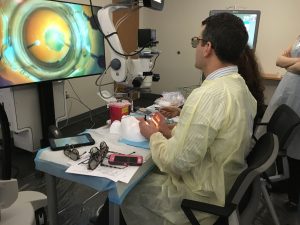
Hands-On Wet Lab
Lectures give you the map. The bench gives you the hands.
The hands-on portion of the day puts fellows behind the scope with the latest surgical techniques and instrumentation, faculty circulating one-on-one. The surgical objectives above are the ones that carry into the lab: filtering surgery, angle-based device work and tube technique.
Because the roster is capped at current glaucoma fellows, the faculty-to-fellow ratio stays low enough for genuine coaching rather than demonstration.
Filtering Surgery
Trabeculectomy technique carried from the didactic session to the practice eye.
Angle & MIGS
Angle visualization and handling of current micro-invasive devices and instrumentation.
Drainage Devices
Tube and plate technique for the eyes that need more than the angle can give.
Bench groupings follow the course’s published surgical objectives · Wet Lab A runs 10:30 am to noon and Wet Lab B 3:30 to 5:00 pm
Who is teaching →Hour by Hour
Friday, October 23, 2026 at Duke Eye Center. Talks and wet lab alternate through the day, and a reception closes it.
Morning
- 7:00 – 8:00 amBreakfast and Exhibits
- 8:00 – 8:10 amWelcome and IntroductionsLeon W. Herndon Jr., MD
- 8:10 – 8:30 amGlaucoma Disease Prevalence and Workforce ImplicationsKelly Muir, MD
- 8:30 – 8:50 amInsights into Glaucoma Patient Education: A Survey of American Glaucoma Society MembersJullia Rosdahl, MD, PhD
- 8:50 – 9:10 amVisual Field Pearls and Head Mounted PerimetryDivakar Gupta, MD
- 9:10 – 9:30 amMIGS OverviewLeon W. Herndon Jr., MD
- 9:30 – 9:50 amMusings on a Career in GlaucomaStuart McKinnon, MD, PhD
- 9:50 – 9:55 amIntroduction to Wet LabsJullia Rosdahl, MD, PhD
- 9:55 – 10:00 amSponsored Presentation I
- 10:00 – 10:20 amBreak and Exhibits and Report to Wet Lab A
- 10:30 am – NoonWet Lab AHands-on
Afternoon
- Noon – 1:00 pmLunch
- 1:00 – 1:20 pmTo be announced
- 1:20 – 1:40 pmAccelerated Epigenetic Aging is Associated with Faster Glaucoma ProgressionHenry Tseng, MD, PhD
- 1:40 – 2:00 pmCataract Surgery in the Glaucoma PatientJoanne Wen, MD
- 2:00 – 2:20 pmThe Next Glaucoma SurgeryLeon W. Herndon Jr., MD
- 2:20 – 2:40 pmUpdate on Inflammatory Glaucoma ManagementKaty Liu, MD, PhD
- 2:40 – 3:00 pmEducation of the Next Generation of TraineesPratap Challa, MD
- 3:00 – 3:05 pmSponsored Presentation II
- 3:05 – 3:25 pmBreak and Exhibits and Report to Wet Lab B
- 3:30 – 5:00 pmWet Lab BHands-on
- 5:00 – 5:25 pmPanel Discussion: Ask Us AnythingFrank Moya, MD · Asra Firozvi, MD · Mohima Sanyal, MD
- 5:25 pmClosing CommentsJullia Rosdahl, MD, PhD
- 5:30 – 6:00 pmReception
Friday · October 23 · 2026
One Day. Both Halves.
Talks on the field’s live debates, two sessions at the bench and a reception to close the day.